
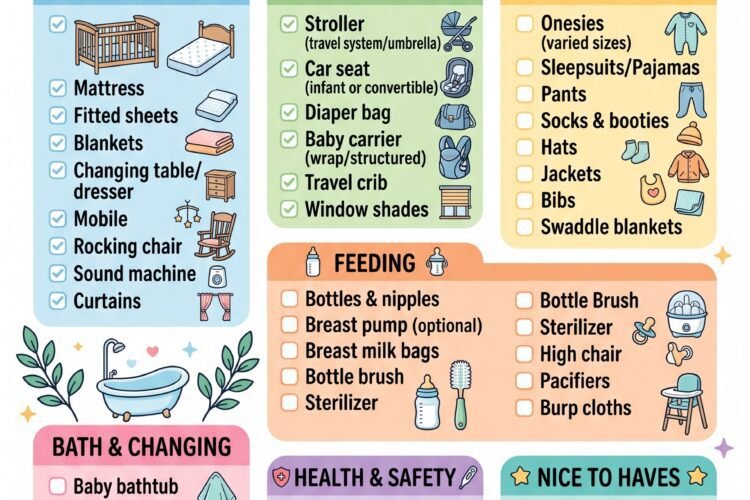
Why Your Registry Deserves a Breath Before You Build It
The very second you tell someone you’re expecting, the registry advice starts. Pinterest boards. Group-chat screenshots. Cousins you haven’t spoken to since 2009 suddenly have opinions about bottle brands. It’s a lot.
Here’s the truth buried under all that noise: a great registry isn’t a wish list. It’s a plan. A plan for how you’ll feed, sleep, bathe, dress, and move your baby through the early months — without buying five things you don’t need or skipping three things you’ll scramble for at midnight.
Most registries fall into one of two traps. Either you register for every “must-have” on a viral list and end up with two bouncers you never used, or you register too cautiously and spend the first month buying things you forgot.
This guide is built around the middle. Use the categories below to register for what you will actually touch every day, with sensible quantities, and skip what doesn’t earn its place. Think of this as your registry’s quiet backbone.
How to Approach Your Registry Like a Smart Shopper
A few habits make registries work harder for you without doubling your list.
Pick Two Retailers (Max Three)
One big-box store for completion discounts and shipping, plus one baby-focused store for the unique stuff (think swaddles, carriers, specialty bottles). Three tends to be the upper limit before tracking becomes its own job.
Register in Second Trimester
Most parents start around 18–20 weeks. That gives you enough hormonal calm to compare options and not enough time for “I’ll add it later” fatigue.
Add Items in Three Tiers
- Tier 1 — Truly essential: Everything below this list
- Tier 2 — Highly useful: Things like a white noise machine, swing, or baby carrier
- Tier 3 — Bonus / wishlist: Items you love but won’t cry without
Quiet categories like books and gift cards handle a lot of the “I want to send something” requests without cluttering your essentials.
Don’t Forget a Completion Discount
Most major baby registry programs offer a completion discount that’s typically usable starting about 60 days before your arrival date and ending about 90 days after. The exact percentage, eligibility window, and minimum-spend rule varies by retailer — check the program’s current terms before your due date so you don’t miss the window for restocking diapers or postpartum supplies. Prime members often receive a higher percentage off; non-Prime usually receives a smaller percentage, with minimum spends around $25 to apply.
Use a Universal Add-To List
If you start at one retailer, see if they offer a universal add-on option so you can consolidate items from specialty stores into one checkout for the completion discount.
Sleep Essentials (The Non-Negotiables)
This is the most safety-sensitive section on your registry. Save it. Pin it. Screenshot it.
What You Really Need
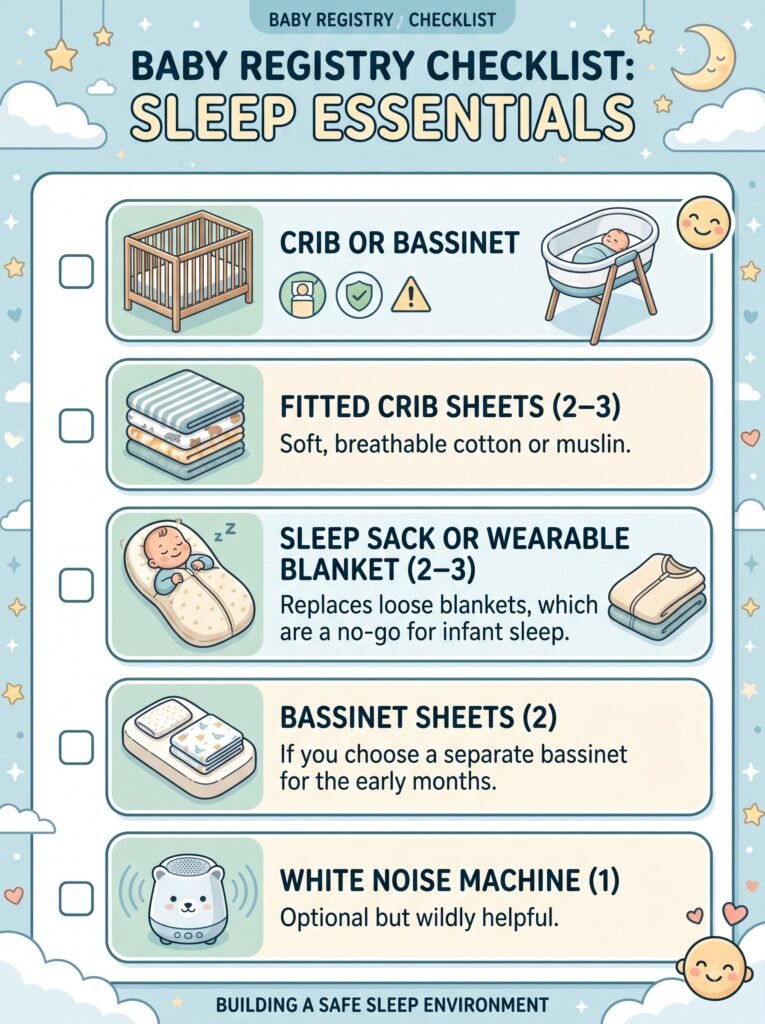
- Crib or bassinet (1) — Pick one that meets current safety standards. Use firm, flat sleep surfaces, a tight-fitting sheet, and nothing else in the sleep space.
- Fitted crib sheets (2–3) — Soft, breathable cotton or muslin.
- Sleep sack or wearable blanket (2–3) — Replaces loose blankets, which are a no-go for infant sleep.
- Bassinet sheets (2) — If you choose a separate bassinet for the early months.
- White noise machine (1) — Optional but wildly helpful.
Sleep Safety Rules to Remember
- Always place baby on the back for sleep.
- Use a firm, flat surface — no inclined sleepers, positioners, pillows, or soft mattresses.
- No loose bedding, bumpers, stuffed animals, or blankets in the sleep space.
- Room-share, don’t bed-share for at least the first six months.
What Real Parents Skip
- Baby positioners, breathing monitors marketed as “anti-SIDS” gadgets, weighted sleep sacks. These create risk and aren’t recommended by pediatric sleep guidance bodies.
Feeding Essentials by Method
You may not know yet whether you’ll exclusively breastfeed, bottle-feed, combo-feed, or pump-round. Cover basics for any path, and outfit deeper for your likely path.
If You Plan to Breastfeed
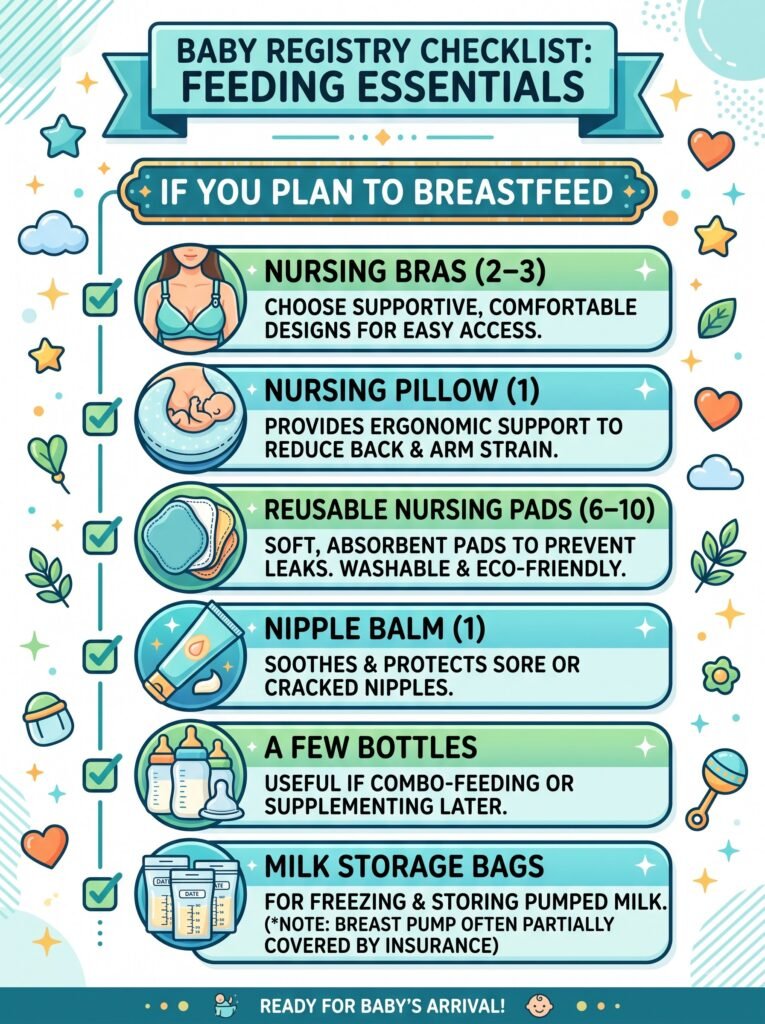
- Nursing bras (2–3)
- Nursing pillow (1)
- Reusable nursing pads (6–10)
- Nipple balm (1)
- A few bottles in case combo-feeding or supplementing later
- Milk storage bags if you plan to pump (breast pump often partially covered by insurance)
If You Plan to Bottle Feed (Formula, Expressed Milk, or Combo)
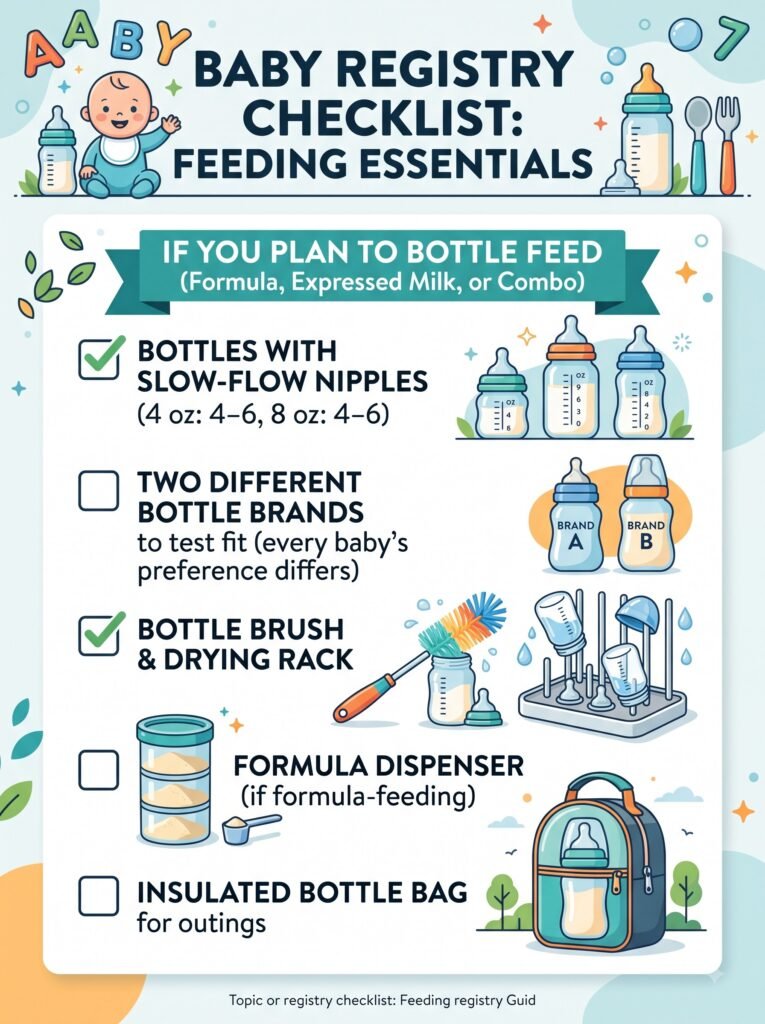
- Bottles with slow-flow nipples (4 oz: 4–6, 8 oz: 4–6)
- Two different bottle brands to test fit (every baby’s preference differs)
- Bottle brush and drying rack
- Formula dispenser if formula-feeding
- Insulated bottle bag for outings
Pro Tip for Either Path
A bottle sterilizer is optional — a boiling-water kettle does the same job. Skip it if drawer space is tight.
Diapering Essentials
You’ll go through more diapers in the first month than any other physical supply in your home. Stock accordingly, but start modestly.
Diaper Station Recommendations
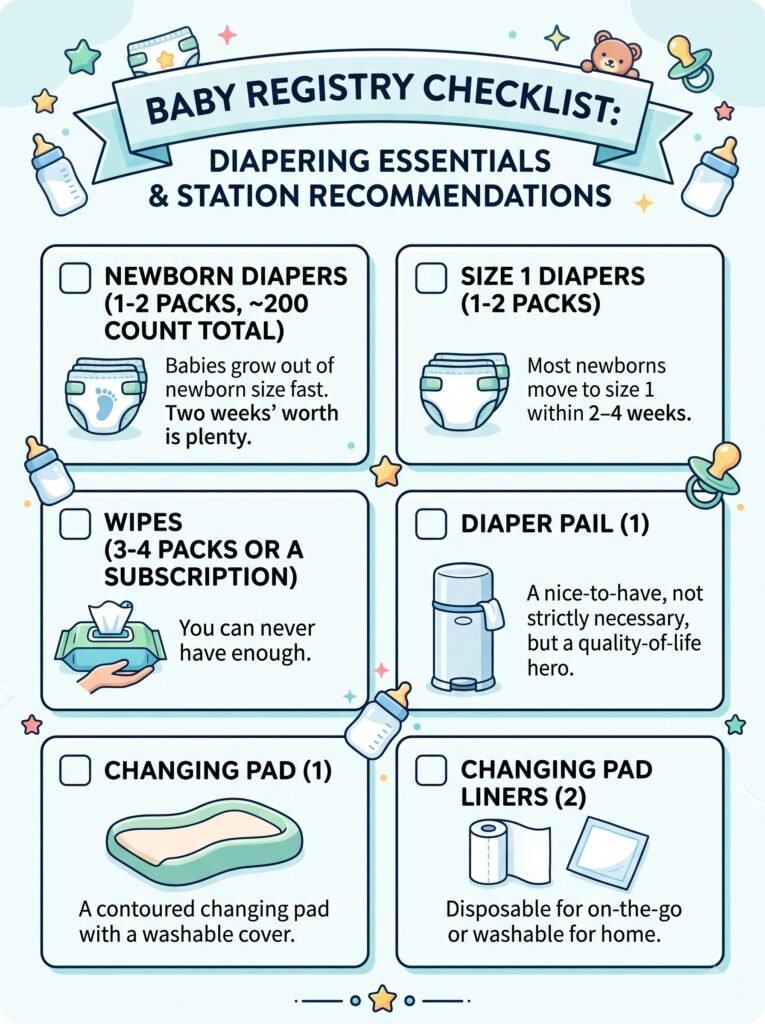
- Newborn diapers (1–2 packs, ~200 count total) — Babies grow out of newborn size fast. Two weeks’ worth is plenty.
- Size 1 diapers (1–2 packs) — Most newborns move to size 1 within 2–4 weeks.
- Wipes (3–4 packs or a subscription) — You can never have enough.
- Diaper pail (1) — A nice-to-have, not strictly necessary, but a quality-of-life hero.
- Changing pad (1) — A contoured changing pad with a washable cover.
- Changing pad liners (2) — Disposable for on-the-go or washable for home.
Cloth Optional
If you’re considering cloth diapers, register for a starter kit of 12–18 prefolds or all-in-ones to trial before committing. Newborn poop is famously runny — make sure you test before stocking up.
Clothing by Size
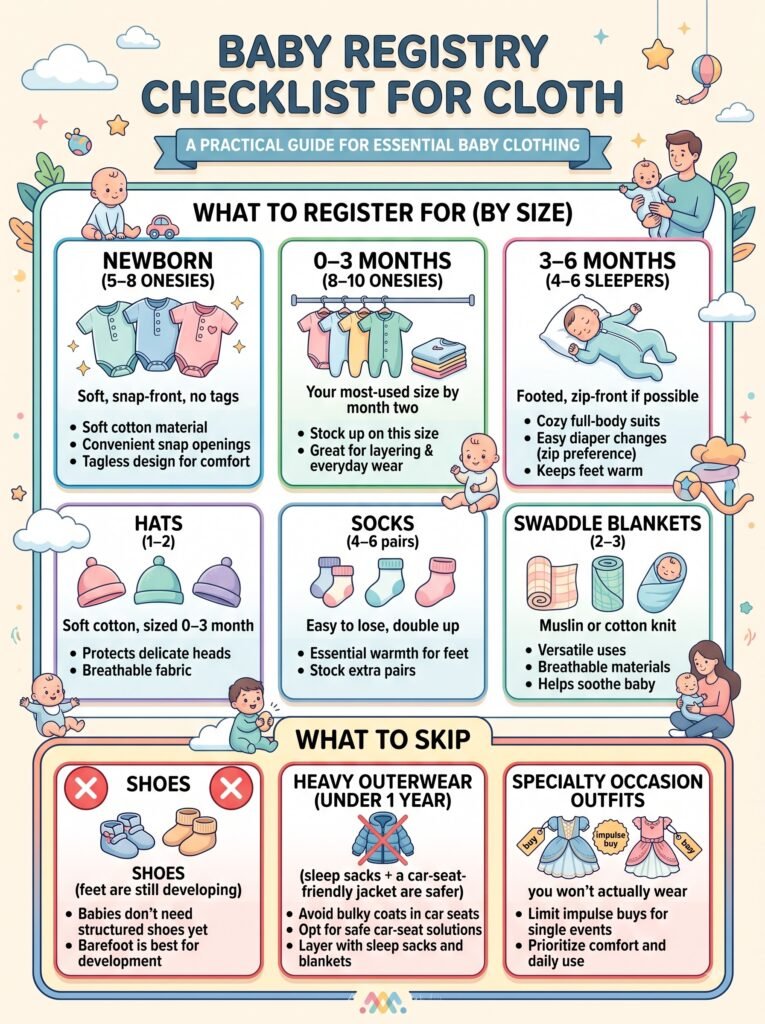
Resist the urge to register for twenty newborn outfits. Most babies blow through that size in two to four weeks.
What to Register For
- Newborn onesies (5–8) — Soft, snap-front, no tags
- 0–3 month onesies (8–10) — Your most-used size by month two
- 3–6 month sleepers (4–6) — Footed, zip-front if possible
- Hats (1–2) — Soft cotton, sized 0–3 month
- Socks (4–6 pairs) — Easy to lose, double up
- Swaddle blankets (2–3) — Muslin or cotton knit
Skip
- Shoes (feet are still developing)
- Heavy outerwear for babies under 1 year (sleep sacks + a car-seat-friendly jacket are safer)
- Specialty occasion outfits you won’t actually wear
Bath & Skincare
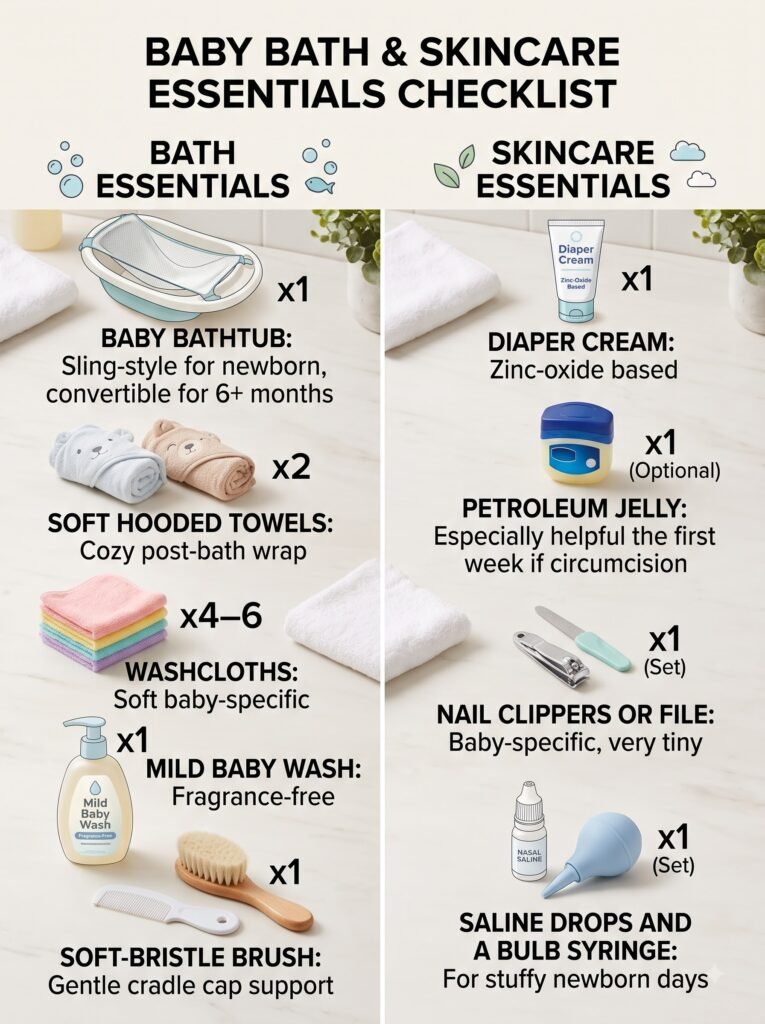
Less is genuinely more here. Babies don’t need much.
Bath Essentials
- Baby bathtub (1) — Sling-style for newborn, convertible for 6+ months
- Soft hooded towels (2) — Cozy post-bath wrap
- Washcloths (4–6) — Soft baby-specific
- Mild baby wash (1) — Fragrance-free
- Soft-bristle brush (1) — Gentle cradle cap support
Skincare Essentials
- Diaper cream (1) — Zinc-oxide based
- Petroleum jelly (optional) — Especially helpful the first week if circumcision
- Nail clippers or file — Baby-specific, very tiny
- Saline drops and a bulb syringe — For stuffy newborn days
Travel: Car Seat, Stroller, Carrier
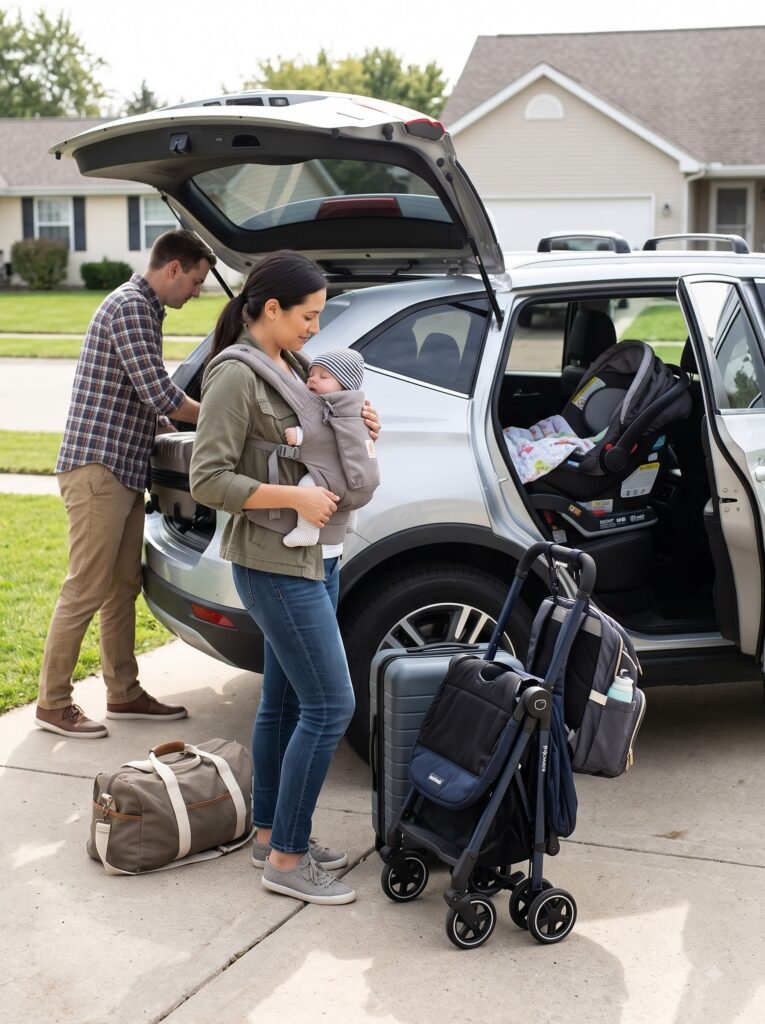
The expense-heavy part of the registry. Build it carefully.
Car Seat (1 — Non-Negotiable)
The single most important purchase on the entire list. Look for:
- Infant-only seat (rear-facing, designed for the newborn months)
- Easy install with clear LATCH or seat belt path
- Crash-tested and meets current federal safety standards
- Compatible with the stroller frame you choose (or independent)
You’ll typically keep an infant seat in the car and bring baby in/out using the carrier handle. Babies graduate to a convertible car seat around 1 year or when they outgrow the height/weight limit.
Stroller
Three core types:
- Travel system — Car seat + frame combo, easiest in the early months
- Lightweight umbrella stroller — Best after 6 months and for travel
- Convertible/modular — Grows with baby, larger investment
If you can only register for one, register for a travel-system-compatible car seat, then add the matching frame. Add a lightweight stroller later as a “post-arrival” purchase with your completion discount.
Baby Carrier (1)
A wrap or structured carrier earns its keep from week one. Look for:
- Newborn-friendly (no insert needed is a bonus)
- Even weight distribution across both your shoulders
- Hip-healthy seat position (M-position, knees above bum)
- Machine washable
Having one carrier you genuinely love changes your first three months.
Health, Safety & Everyday Tools
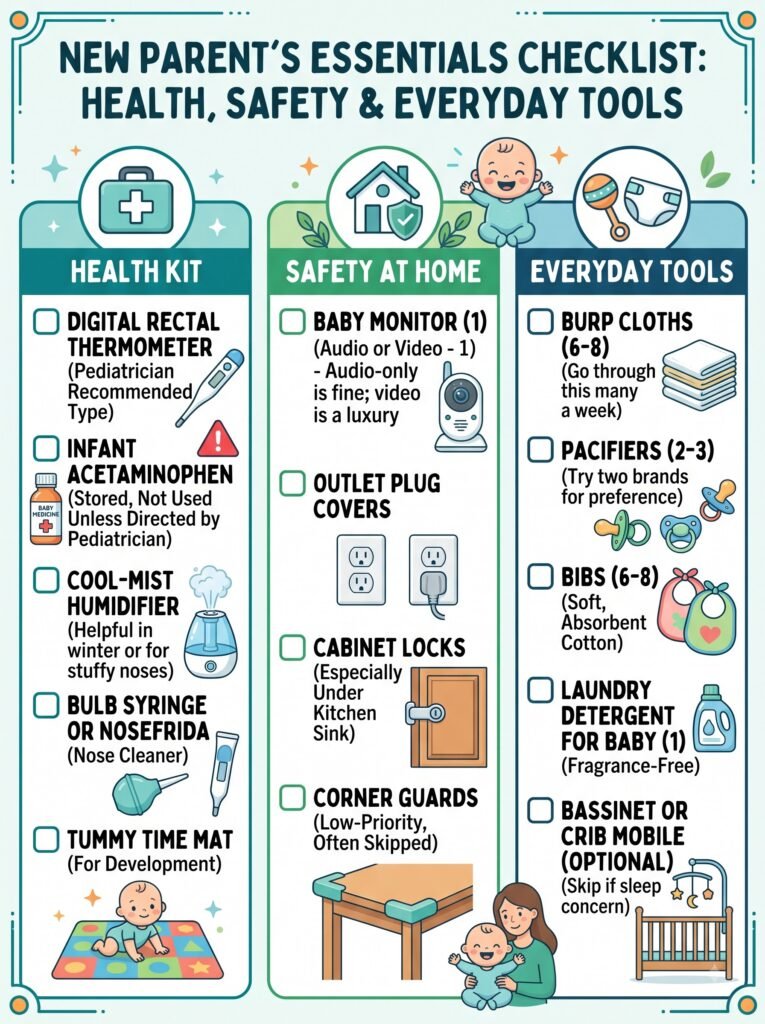
Health Kit
- Digital rectal thermometer (the type pediatricians actually recommend)
- Infant acetaminophen — stored, not used unless directed by your pediatrician
- Cool-mist humidifier (helpful during winter or for stuffy noses)
- Bulb syringe or NoseFrida
- Tummy time mat
Safety at Home
- Baby monitor (1) — Audio-only is fine; video is a luxury
- Outlet plug covers
- Cabinet locks (especially under the kitchen sink)
- Corner guards (low-priority, often skipped)
Everyday Tools
- Burp cloths (6–8) — You’ll go through this many a week
- Pacifiers (2–3) — Try two different brands to find baby’s preference
- Bibs (6–8) — Soft, absorbent cotton
- Laundry detergent for baby (1) — Fragrance-free
- Bassinet or crib mobile (optional) — Skip if concerned about sleep associations
Postpartum Picks for Mom (You Count Too)
Most registry guides forget the person doing the recovering. Don’t skip yourself.
Post-Birth Recovery Essentials
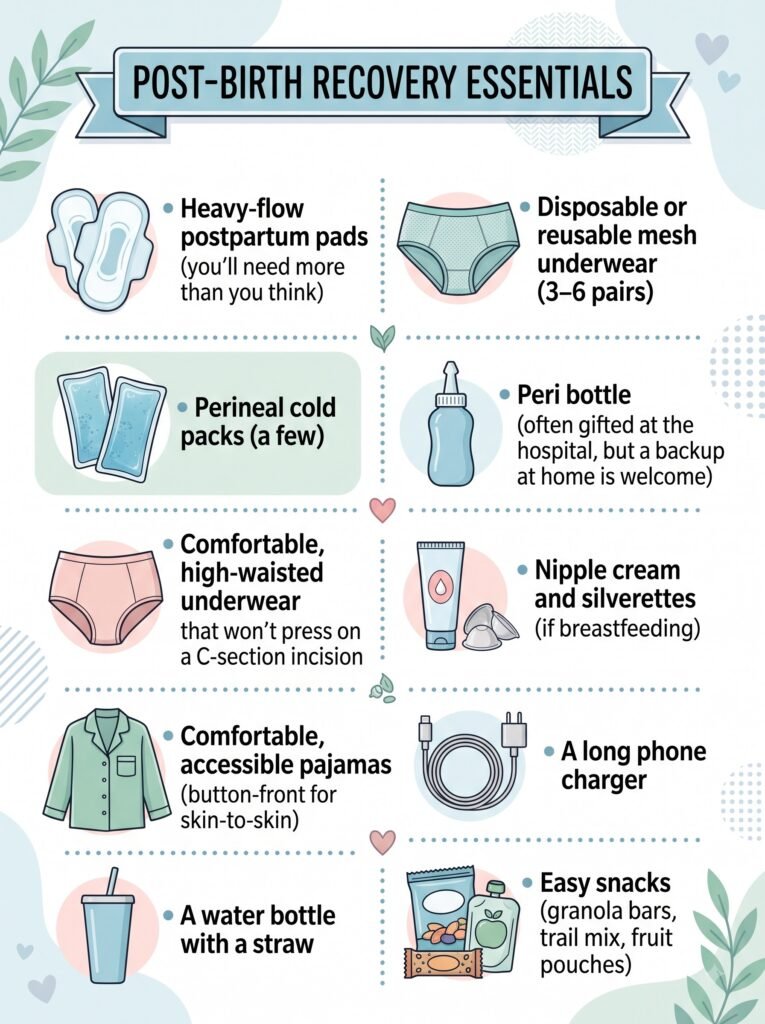
- Heavy-flow postpartum pads (you’ll need more than you think)
- Disposable or reusable mesh underwear (3–6 pairs)
- Perineal cold packs (a few)
- Peri bottle (often gifted at the hospital, but a backup at home is welcome)
- Comfortable, high-waisted underwear that won’t press on a C-section incision
- Nipple cream and silverettes (if breastfeeding)
- Comfortable, accessible pajamas (button-front for skin-to-skin)
- A long phone charger
- A water bottle with a straw
- Easy snacks (granola bars, trail mix, fruit pouches)
Items Often Covered by Insurance
- Breast pump
- Compression stockings (sometimes)
- Postpartum support belt (sometimes)
Call your insurance early in the third trimester so you don’t miss deadlines.
Mental Health
- A list of postpartum support contacts ready
- A friend check-in calendar
- A partner communication plan for the first two weeks
- Access to a postpartum therapist’s contact (pre-stored)
- A “no visitors until I’m ready” script for boundaries
What Real Parents Skip (The Honest Skip-List)
These are the items new parents commonly register for and then rarely use.
Common Skip-List
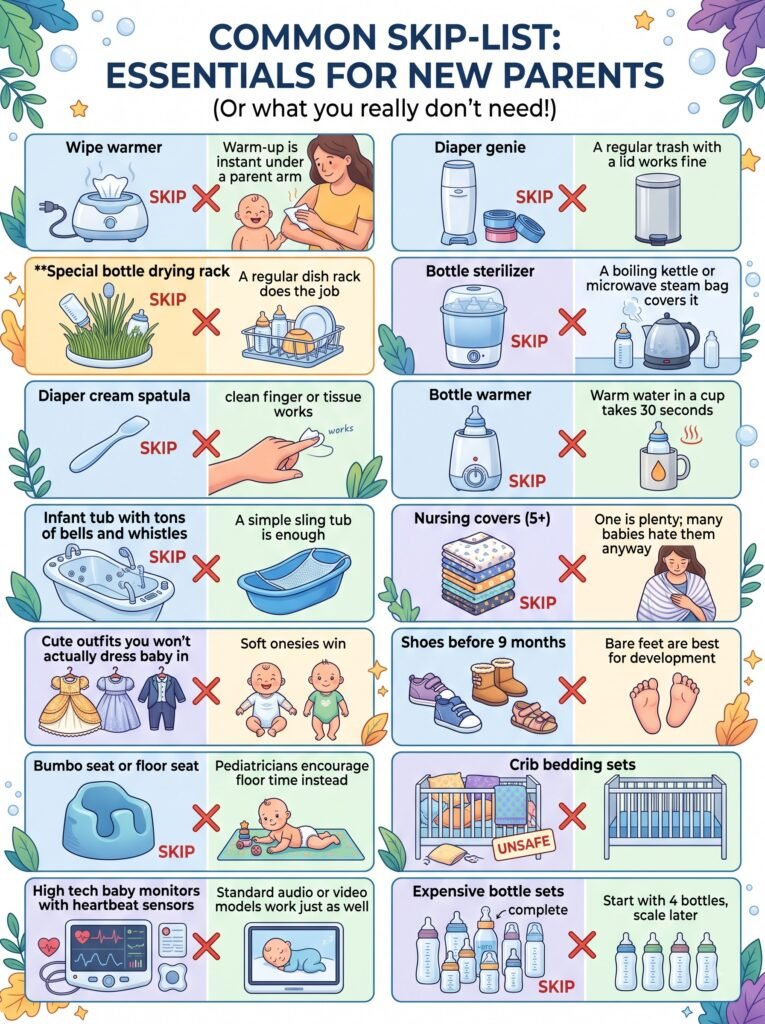
- Wipe warmer — Warm-up is instant under a parent arm
- Diaper genie — A regular trash with a lid works fine
- **Special bottle drying rack — A regular dish rack does the job
- Bottle sterilizer — A boiling kettle or microwave steam bag covers it
- Diaper cream spatula — A clean finger or tissue works
- Bottle warmer — Warm water in a cup takes 30 seconds
- Infant tub with tons of bells and whistles — A simple sling tub is enough
- Nursing covers (5+) — One is plenty; many babies hate them anyway
- Cute outfits you won’t actually dress baby in — Soft onesies win
- Shoes before 9 months — Bare feet are best for development
- Bumbo seat or floor seat — Pediatricians encourage floor time instead
- Crib bedding sets — Loose bumpers and comforters are unsafe
- High tech baby monitors with heartbeat sensors — Standard audio or video models work just as well
- Expensive bottle sets — Start with 4 bottles, scale later
Rule of thumb: If you’ll only use it once, register for the cheaper version. If you’ll use it daily, register for the better build.
Used-Gear Safety Checklist
Many parents receive or buy gently-used baby items. Here’s a quick safety pass.
Used Car Seats — When to Skip
Don’t use a used car seat if any of these apply:
- The seat is past its expiration date (check the sticker on the seat)
- The seat has been recalled (manufacturer databases let you check by serial number)
- The seat has been in a moderate to severe crash
- The instruction manual is missing
- The labels (model number, manufacture date) are unreadable
- The seat was hand-me-down more than 6–8 years ago
- Fabric is visibly damaged, frayed, or sun-faded to weakness
Used Cribs / Bassinets
- Drop-side cribs are unsafe and banned; skip them entirely
- Crib slats should be no more than 2 3/8 inches apart
- Wood should be solid, with no cracks, peeling, or missing hardware
- Mattresses should still feel firm and flat with no soft spots
- Confirm the crib still meets current federal safety standards
Used Baby Carriers
- Skip any with frayed fabric or stretched buckles
- Skip any with a recalled label (check manufacturer databases)
- Soft-structured carriers typically last well; wraps last longer
Used Bouncers, Swings, and Rockers
- Skip any with cracked plastic or unstable bases
- Skip with missing restraint straps or buckles
Safe to Buy Used
- Baby clothes (wash hot)
- Books
- Stuffed animals (wash or air-out only)
- High chairs (if all straps and trays are intact)
- Toys in good condition with no chipped paint
- Boppy-style pillows
- Bassinets, if structurally sound (no drop-side models)
If a deal feels too good to be true on safety gear, it usually is. Sometimes new is peace of mind worth paying for.
Printable Master Checklist
Save this. Repeat as a single pack-and-go shopping list.
Sleep
- ☐ Crib OR bassinet (current safety standards, JPMA-certified)
- ☐ 2–3 fitted crib sheets
- ☐ 2 sleep sacks (appropriate TOG for season)
- ☐ White noise machine
Feeding
- ☐ 6–8 bottles with slow-flow nipples (2 brands)
- ☐ Bottle brush + drying rack
- ☐ Nursing pillow (if breastfeeding)
- ☐ Nursing bras (2–3) if breastfeeding
- ☐ Milk storage bags if pumping
- ☐ Formula starter if formula-feeding
- ☐ Burp cloths (6–8)
Diapering
- ☐ Newborn diapers (1–2 small packs)
- ☐ Size 1 diapers (1 pack)
- ☐ Wipes (3+ packs or subscription)
- ☐ Diaper pail (optional)
- ☐ Changing pad with 2 covers
- ☐ Diaper cream (zinc oxide)
Bath & Skincare
- ☐ Baby bathtub
- ☐ 2 hooded baby towels
- ☐ 6 soft washcloths
- ☐ Fragrance-free baby wash
- ☐ Soft baby brush
- ☐ Baby nail clippers
- ☐ Saline drops + bulb syringe
Clothing
- ☐ 5–8 newborn onesies
- ☐ 8–10 0–3 month onesies
- ☐ 4–6 sleepers (footed, zip-front)
- ☐ 2 soft hats
- ☐ 4–6 pairs socks
- ☐ 2–3 swaddle blankets (muslin)
Travel
- ☐ Infant car seat (rear-facing, current safety standards)
- ☐ Travel-system-compatible stroller OR carrycot-friendly stroller
- ☐ Baby carrier (newborn-friendly, hip-healthy, machine-washable)
Health & Safety
- ☐ Digital thermometer
- ☐ Cool-mist humidifier
- ☐ Pacifiers (2–3 brands to test)
- ☐ Baby monitor
- ☐ Outlet covers
- ☐ Cabinet locks (especially under the kitchen sink)
Postpartum For Mom
- ☐ Heavy-flow postpartum pads
- ☐ Reusable/disposable mesh underwear
- ☐ Perineal cold packs
- ☐ Peri bottle
- ☐ Nipple cream + silverettes (if breastfeeding)
- ☐ Button-front pajamas
- ☐ Long phone charger
- ☐ Straw water bottle
- ☐ Easy snacks
- ☐ Postpartum therapist contact saved
Skip (For Now)
- ☐ Wipe warmer
- ☐ Diaper genie
- ☐ Specialty bottle sterilizer
- ☐ Crib bedding sets with bumpers
- ☐ Pre-walker shoes
- ☐ Bumbo / floor seat before baby shows interest
Common Registry Mistakes First-Time Parents Make
- Registering for too many sizes at once. Three sizes of diapers? Save size 2 and 3 for after-birth purchases with the completion discount.
- Skipping the car seat research. It’s the most safety-critical purchase. Don’t buy on aesthetics alone.
- Adding twelve bibs “just in case.” You need roughly six; the rest end up folded in a drawer forever.
- Discounting hand-me-downs gently. Used baby clothes, books, high chairs — totally fine. Used car seats and cribs need that extra safety checklist above.
- Forgetting postpartum items for mom. Recovery is real and it lasts weeks.
- Registering for a million bottles without testing. Every baby prefers a different nipple flow and shape.
- Buying a bassinet and a crib at the same time. Bassinet for the first 3–5 months, then transition to crib.
- Skipping the completion-discount fine print. Most programs have a minimum spend and a window — typically around 60 days before arrival date to 90 days after, with discounts of around 10% (or 15% for Prime-equivalent members). Know the rules before baby arrives.
- Trusting viral TikTok “must-haves.” Many are sponsored content or hype-driven. Always pair recommendations with what you’ll actually use.
- Choosing baby clothing by cuteness instead of comfort. Soft, easy-snap, breathable pieces always win.
- Adding multiples of the same gift-card style item. Ten $25 gift cards become a tracking mess. One or two max.
- Forgetting items specific to your climate. Winter babies need a heavier sleep sack (higher TOG). Summer babies need a lighter sleep sack and a stroller fan.
Frequently Asked Questions
1. How early should I start my baby registry?
Most parents build the bulk of their registry between 18 and 22 weeks. That’s slow enough to enjoy comparing options and fast enough to leave room for shower invites. Add items as you discover favorites, but don’t wait past 30 weeks.
2. Should I register for more than one store?
A primary big-box store plus a specialty store is usually the sweet spot. Two stores give you enough variety for unique essentials without losing track of completion discounts. Three can work but add three shipping accounts and three returns processes.
3. Are gift cards a good registry item?
A small number of gift cards — usually one or two — is helpful. They’ll pick up anything your registry missed, from postpartum comfort items to bigger-ticket gear like a convertible car seat around month one. Avoid stacking five small cards; it complicates gifting.
4. What can I confidently buy used?
Clothes, books, high chairs (with full straps), most toy boxes in good condition, baby swings and bouncers in good structural shape, and bassinets without drop-side hardware. Skip used car seats, drop-side cribs, and items missing manuals.
5. Do I really need a baby monitor?
If baby sleeps in your room for the first six months, you don’t need a monitor — your ears do the work. After that transition, a basic audio monitor is plenty. A video monitor is a quality-of-life upgrade, not a safety necessity.
6. How many bottles should I register for?
Eight to twelve of your likely-size bottle is a safe starter. Babies often prefer one type; pick your top two candidates and buy a few of each. Plenty of extras for caregivers, daycare, and emergencies.
7. What about a baby swing or bouncer? Do I need both?
Most parents find one works. A baby swing tends to soothe younger babies, while a bouncer becomes useful after about four months when babies enjoy kicking and watching toys attached above. Pick one to register for and add the other later if needed.
8. How do diaper subscriptions work?
Subscription services ship diapers in cycles (typically monthly or every few weeks). They’re excellent for the steady middle stages — size 2 and up. Newborn size is sometimes worth buying on its own because babies outgrow it within weeks.
9. Should I register for breast pump supplies if I’m not 100% sure I’ll breastfeed?
Yes, especially if your insurance covers a pump at no cost. The supplies — flange inserts, milk bags, a hands-free bra — are useful whether you breastfeed, combo-feed, or exclusively pump. Save the breast pump itself as an insurance-covered item if eligible.
10. What should I skip on most “Top 10 Baby Registry” lists?
Common overhyped picks: wipe warmers, bottle sterilizers, positioners, anti-SIDS gadgets, crib bedding sets, expensive bottle warmers, decorative bulky furniture like diaper stackers. These read well on Pinterest but rarely get touched.
11. When should I run my completion discount?
The completion window typically opens around 60 days before your arrival date and closes about 90 days after. Use it on the items you need once you’ve lived with baby for a few weeks. Diapers, postpartum comfort items, and a few size-up clothing pieces are great targets.
12. What’s the best single biggest-ticket item to register for?
The infant car seat. It’s the most safety-critical purchase you’ll ever make for your child. Invest in one that meets current safety standards, fits your vehicle correctly, and is comfortable to carry.
Final Thoughts
A registry is not a personality test. You don’t need to prove anything by adding every viral must-have or by paring down to a minimalist list of 12 items. You need a registry that works for your home, your baby, your family, your budget.
Start with the essentials above. Add two or three things you genuinely love. Be honest about what you can borrow or buy secondhand. Reserve a few slots for the treats you want — a beautiful swaddle, a long-promised cozy rocker, a brand of bottles that feels special. Then stop.
The best registry doesn’t fill your home. It fills your first month with the comfort of knowing you have what you need.
Be gentle with yourself. Your baby won’t care whether the swaddle was the trendiest one. They’ll care whether you’re rested enough to hold them close.
Happy registering. You’re going to be wonderful.